
We read a chapter out loud most nights for about two years. It worked maybe half the time. The other half, someone read, everyone nodded, and the conversation was over before it started.
The problem was never the Bible. It was that we had nothing to answer. Reading is passive. A page that asks you a question is not.
So these three journals have almost no words in them. Every page gives you one verse, in full, and three questions. Then blank lines. That is the entire design.
What is on a page
A day number and a title. “The meal nobody thanked anyone for.” “A diagnosis.” “The friend who told you the truth.” You should be able to tell from the title whether today is your day.
One complete verse, printed in full and quoted from the World English Bible, which is in the public domain. No paraphrase, no verse fragment pulled out of its sentence, no cross-references to chase.
Three questions. The first asks what the verse actually says — its wording, its order, the one word doing the work. The second turns it on your week: not “what does this mean to you” but “when did you last do this, and to whom.” The third asks for one thing you could do, or say, before the day ends. The order matters. You cannot apply a verse you have not read.
Four ruled lines under each question. Enough to write a real answer, not enough to write a sermon.
The three journals
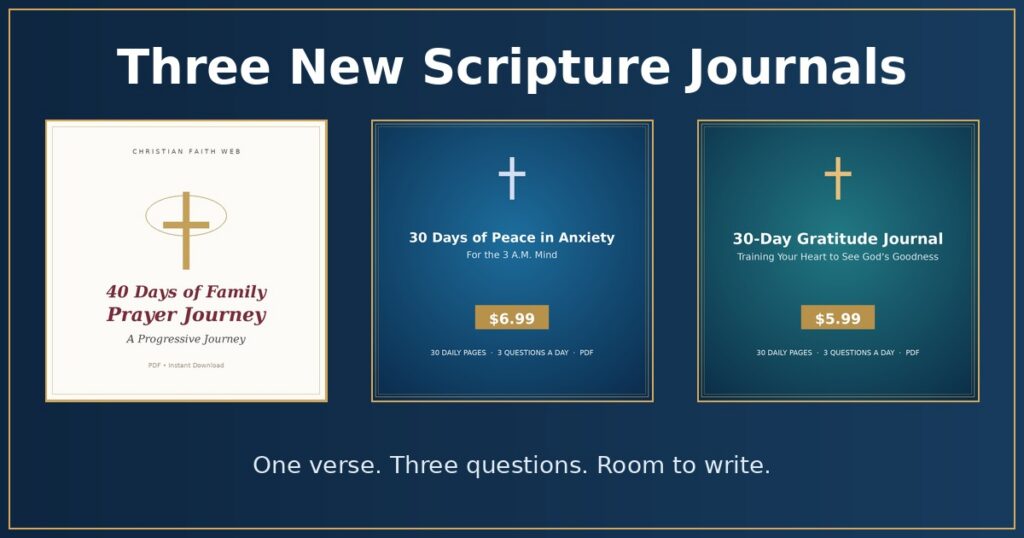
40 Days of Family Prayer — $6.99, 43 pages. Forty nights, about ten minutes each, for a household to do together. It moves through hospitality, confession, money, complaints, forgiveness between siblings, and praying for people outside the house. If your family has tried and quit twice already, this is written for the third attempt.
For the 3 A.M. Mind: 30 Days of Peace in Anxiety — $6.99, 33 pages. Thirty specific situations rather than thirty abstract words: the hour you wake up and cannot get back to sleep, a bill you cannot pay, a diagnosis, an email you are afraid to open, a waiting room. The how-to page says plainly that this is not medical advice and that if fear has moved into your body, you should see a doctor, a counsellor, or your pastor. I would rather say that on page three than sell you something that pretends otherwise.
30-Day Gratitude Journal: Training Your Heart to See God’s Goodness — $5.99, 33 pages. Thirty days on noticing: water on an ordinary day, a chair that held you, a debt that was cancelled, a door that closed and what opened after it. Gratitude is a habit of attention before it is a feeling, and the questions are built that way.
What these are not
They are not devotionals. There is no commentary, no illustration from the author’s life, no teaching section, and no closing prayer written for you. If you want a passage explained, this is the wrong product and I would rather you know that now.
They are also not workbooks with a syllabus. There is no week-one-to-week-four arc you can fall behind on. Miss four days and the next page still works.
You can see a page before you buy
Each product page now shows a photo of Day 1, taken from the actual file — the verse, all three questions, and the four lines, exactly as they will print. All three are PDFs you print at home, and the whole set comes to $19.97.
If you have been reading the Bible with your family, or alone at 3 a.m., and it has felt like a box to tick, start with one page. One verse, three questions, four lines. It takes about ten minutes, and it is the first thing we have found that a tired household will actually finish.